Sunday, 7 December 2014

7th December

Amazingly, I saw my second new bird of the weekend this morning- what a great couple of days!

About a week ago, a Barred Warbler had appeared in a mist net at Portland Bird Observatory. This was a remarkable record. This species is a scarce passage migrant to the UK, breeding from central and eastern Europe to central Asia and wintering in tropical East Africa. Around 100 are seen in Britain each year, virtually all of which are first winters in September-October along the east coast. As far as I know, this individual is the first to be recorded in Britain in December, when it should be enjoying the warmth of Kenya... I know where I'd rather be! I had hoped that the bird would stay at Portland until the weekend, however it disappeared for four days, before reappearing yesterday evening. Thankfully, it was still there this morning:


Barred Warbler, Portland Bird Observatory. What an awesome bird!
The Obs at Portland has started to put apples out for the Blackcaps that spend the winter there and quite remarkably, the Barred Warbler has taken a liking to them too. This bird was noticeably chunky- much, much larger than the female Blackcap that was also feasting on the fruit. Its size, combined with its really rather evil eye, combine to give this bird a rather fearsome appearance- certainly not an appearance normally associated with the warbler family. What a beast! The odds on me seeing a Barred Warbler feeding on apples about ten yards away on a cold and windy December Dorset day must have been pretty slim...

Also at the Obs was the corpse of a Hoopoe that had sadly been found dead the previous day, most likely having been killed by a cat. Seeing this magnificent bird so close up was incredible- its wing feather patterns are absolutely remarkable, but it really was sad to see such a resplendent beast lifeless.

My next stop was Portland Castle, where I was lucky to find a female Eider hiding incredibly effectively on some seaweed-covered rocks just offshore:
Female Eider, Portland Castle. Not the best picture, but it was so well-camouflaged that this was the only time I managed to find it in the camera!
This was only my second Eider ever, and my first in about ten years. Alongside it were several Red-breasted Mergansers and I also had distant views of a Black-throated Diver flying over the harbour from Hamm Beach. It was a good morning!


Saturday, 6 December 2014

Another Siberian vagrant...

I saw my fourth Siberian vagrant of the autumn this morning, with a Richard's Pipit at Redcliff Point near Weymouth.

 This species breeds in Siberia, Mongolia and northern China and normally spends the winter from India to Malaysia, however, like a number of other Siberian birds, it is showing an increasing tendency to appear in Western Europe in autumn and to overwinter in the Middle East, North Africa and Iberia. This was a great new species for me and a very unexpected one to see so late in autumn. It really is not the most exciting bird in terms of looks, but it is truly remarkable that it has travelled so far to end up in a field near Weymouth. What an awesome bird!

Sunday, 23 November 2014

Weymouth/Portland area- 22nd November

On the 22nd, I decided to try to see as many bird species as possible within a 12 mile radius of Weymouth, which would include Portland Bill to the south, Maiden Castle to the north, Abbotsbury to the west and Ringstead Bay to the east. Sadly, I ran out of time to search the latter two places properly, but I had some great success in the areas I did visit. 

I started at 10 30 at Maiden Castle. Here, I hoped to pick up some farmland species that may be difficult to find later on in Weymouth. The first bird of the day was Carrion Crow, shortly followed by a flock of approximately 300 Golden Plovers flying overhead and a number of the more regular countryside species, including Buzzard, Fielfare and 200 or so Lapwings. The highlight here for me was finding ten or so Corn Buntings, nowadays a very rare bird in Dorset.
Corn Bunting, Maiden Castle
This plump bird was once abundant in Dorset, but due to changed farming methods, the species has declined enormously and now has a very small and fragmented range in the county. Thankfully, the bird seems to be doing well around Maiden Castle.

My next stop was Lodmoor RSPB in Weymouth. I hoped to pick up heaps of wetland birds here, and I was not disappointed. A number of the more common waterfowl put in an appearance, along with three Common Snipes and, best of all, a Marsh Harrier. I had also managed to find the potentially-difficult Goldcrest here and my first Cetti's Warbler for a couple of years. A single Mediterranean Gull was present along with several Common Gulls.

I then travelled to Ferrybridge in search of the waders which had been virtually completely absent from Lodmoor. Sadly, someone had decided to start digging for fishing bait right in front of the visitor centre and had consequently flushed all waders and geese from the area. I managed to find some (very) distant Dunlin, Brent Geese and Red-breasted Mergansers, along with a single Redshank and a couple of other new species for the day. I knew this was basically my only chance at picking up such waders as Ringed Plover, Sanderling, Grey Plover and Knot, but sadly there was no sign of any. On the other side of the road, I picked up my first Turnstones and Rock Pipits, along with a fantastic hovering Kestrel. Four distant Grebes in Portland Harbour were most likely Little Grebes, but they were far-too-far away to eliminate something more interesting. 

Portland Castle was next, where a Great Northern Diver was swimming around offshore, along with a Shag. Divers are among my favourite birds and it was a real pleasure to watch this great species. Sadly I was unable to locate the Black Guillemot that had been seen there earlier in the morning. Two great Black Redstarts made for a fantastic sight, which more than made up for missing the guillemot.


Black Redstart, Portland Castle
The trees behind the castle were bizarrely empty compared to last weekend, when they had been teeming with not only Black Redstarts, but also Chiffchaffs, thrushes and finches. Today they were virtually empty.

I then continued on to Portland Bill. Immediately, I found a Peregrine Falcon soaring above the rocky cliffs- this was a good start. I walked down to the Pulpit Rock, in search of Purple Sandpipers, which can often be found around this area during the winter months. I quickly found several waders scurrying about the rocks, though they turned out to be Turnstones.
Turnstone, Portland Bill
Though often ignored, this really is a remarkable species, with a breeding range extending across the entire Arctic, from Alaska and Canada to Scandinavia and Greenland and everywhere in between. It then travels south for the winter, commonly as far as South Africa, Australia and New Zealand. What an awesome bird!

After a long search, I eventually found a single Purple Sandpiper, and quickly four more appeared.
Purple Sandpiper, Portland Bill
Watching these birds as they fed perilously close to a large swell was an awesome experience. They would regularly have to fly rapidly away from their perch to avoid being swept away by the powerful waves that were breaking over the rocks. Like the Turnstones, their camouflage is truly remarkable- they are almost impossible to spot against the rocky background. This was only my second sighting of this Arctic-breeding species and it was awesome to watch the birds from such a close distance.

I still had several easy species to pick up from the Bill, so I soon had to drag myself away from the Purple Sandpipers and continue my search. Finding a Stonechat proved to be easy, the others, however, proved to be much more difficult. I ended up wasting a considerable amount of time in finding Raven and Gannet and sadly no Fulmars had appeared. My next stop was the Obs Quarry, where I was extremely lucky to have a brief view of one of the Little Owls- my second sighting of this species in as many visits to the Bill after dozens without seeing them. I had no such luck during my search for Short-eared Owls in the top fields behind the observatory- my first Skylarks of the day being the only compensation- it didn't really make up for it... I then decided to head to Radipole, stopping off at Portland Castle and Ferrybridge again on the way. At the castle, I eventually found the Black Guillemot and a huge number of Ringed Plovers had returned to Ferrybridge. Sadly I had missed Sanderling, Grey Plover and Knot though... Arriving at Radipole, new birds for the day continued to appear, including a Shoveler and dozens of Black-tailed Godwits at the visitor centre. The Hooded Merganser was unfortunately hiding, so I quickly moved on, further into the reserve. A number of very common birds were still missing from my day's list, but sadly only one of them- the Greenfinch appeared. I didn't care at all though, as I chanced upon a flock of 35 or so Bearded Tits, undoubtedly one of Britain's coolest birds. Genetic testing has shown that they have no close relatives anywhere in the world, and the species is consequently in a family of its own. Sadly, they were moving too fast for a photograph, but I happily settled for watching this great species really close. Rushing back to the carpark, I happened to find a Water Rail creeping about some reeds- what an awesome few minutes it had been! Sadly, the Hooded Merganser was still absent and with darkness fast approaching, I hurried to Abbotsbury hoping to add a couple more species to the tally. It was virtually completely dark by the time I arrived, and as a result it was impossible for me to try and pick up any Pochard or Pintail in amongst the large flocks of waterfowl at the swannery. A large number of Pheasant  and a single Sparrowhawk were my only consolidation...

 Shoveler (top) and Shelduck, Radipole Lake RSPB

I ended up seeing 80 species, which I felt was not too bad. Had I started earlier in the day (thus avoiding some of the traffic) and allowed myself some more time, I think that 100 species could have been feasible. I missed a number of very common species, including Song Thrush, Redwing and Great Crested Grebe and with a bit more luck, finding twenty more species shouldn't be too hard. I shall try again at some point....

 Here is a list of species seen.


Monday, 17 November 2014

15-16th November

On the 15th, I was lucky enough to find a distant Greenland Greater White-fronted Goose from the coast path behind Abbotsbury Swannery in with a flock of Canada Geese, along with a singe Scaup in among a large flock of Pochards, Tufted Ducks and Mallards. This was my second sighting of both species and made for a nice bonus on a great walk.
Greenland Greater White-fronted Goose, Abbotsbury. What an amazing thought it is that this bird has travelled to Dorset all the way from the High Arctic.

The next day, we got up early and travelled to Portland, in search of a rare Siberian vagrant. After a short wait, the Dusky Warbler appeared in a small bramble patch off Avalanche Road. We had great views, but the bird was extremely mobile and far too fast for the camera. This species breeds from central Siberia eastwards and should be well on its way to Thailand right now, however this individual has become rather lost to say the least. I suspected that the bird may appear similar to a darker, browner Chiffchaff, though I was pleasantly surprised to discover that this bird was much more distinctive than expected. Its behaviour was very similar to that of the Pallas's Warbler that I saw several weekends ago, moving frantically about the brambles, occasionally pausing to do some fly-catching. It was a really great bird to watch and a very pleasing new species for me. In the same brambled area, there were two Chiffchaffs and several Redwing flocks flew overhead.

We then moved on to Portland Castle, hoping for some Divers to be showing well offshore. Sadly our search was in vain (except for a group of c.14 Red-breasted Mergansers), though finding eight Black Redstarts behind the castle more than made up for it.
Black Redstart, Portland Castle
This is one of my favourite bird species, really invoking memories of the south of France and Morocco and they appeared well and truly out of place hopping around the dingy wasteland behind the castle on this cold and rainy November day. I have never seen such a large number together in the UK and watching them made for a really enjoyable experience. Nearby were approximately 12 Chiffchaffs and several more Redwings, as well as my latest-ever Wheatear, beating the bird I saw at Portland Bill 16 days ago. Soon, the rain became unbearably heavy and we had to head home, very pleased with the morning.

Monday, 3 November 2014

1st November

As this was the final day that I would be able to go birding for quite some time, we headed down to Portland.

On arrival at the observatory, we found a large crowd of birders searching for a Pallas's Leaf Warbler that had been seen in the garden twenty minutes earlier. It was extremely windy, and consequently I feared that the chances of it reappearing would be very small indeed. After an anxious fifteen-minute-wait, I saw a minute bird briefly appear flying between some bushes in the garden. Its extraordinarily-bright green colouring meant that it was almost certainly the Pallas's, though my view was hardly satisfactory. Thankfully, less than a minute later, it appeared much closer (literally two metres away), rapidly moving through a thick bush. It was a truly awesome sight- this 9cm-long bright little jewel of a bird that had travelled all the way from Siberia was really one of my favourite sightings of all time. It was moving far-too-fast for a photograph to be possible, but I really couldn't have cared less. The species has become increasingly common in Britain (over 300 were seen in one year alone), seemingly due to changing migration habits- rather than spend the winter in tropical China, a decent number seem to spend it in western Europe nowadays (perhaps a result of climate change?). I was so glad to have finally broken a terrible run of dipping in recent weeks and it was my first new British bird since May, and what a fantastic way to do it.

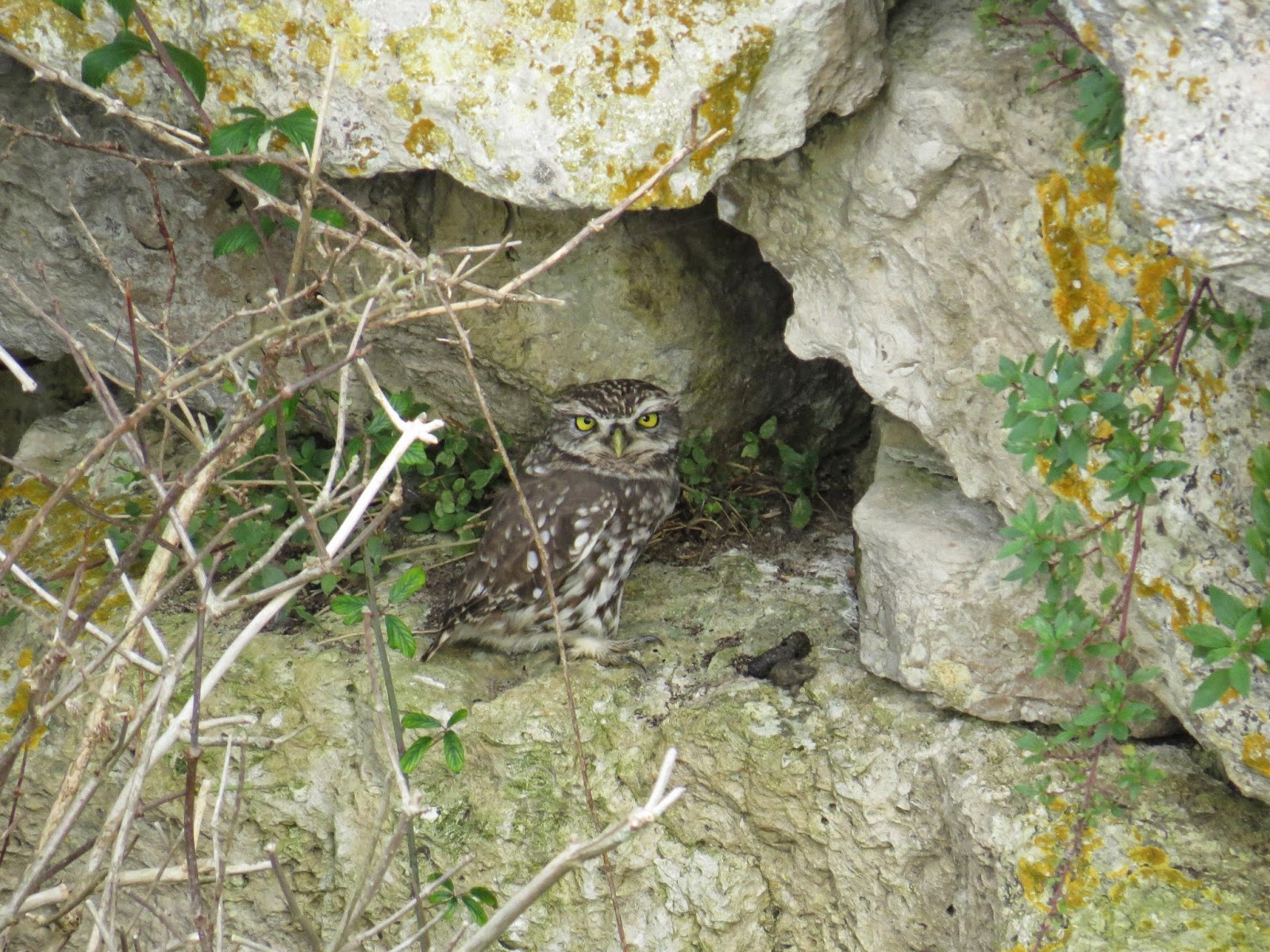
Feeling that luck was on our side, we decided to try and end another terrible run- somehow never seeing the Observatory Quarry's resident Little Owls which had somehow escaped me on my very numerous visits to the area. Inevitably, one was showing exceptionally well on a rocky perch that I have checked dozens of times before.
Little Owl, Portland Bill

What an awesome bird! It was very much worth the wait....

At the Bill itself, we hoped to find some Black Redstarts. Sadly, the sheer number of people present presumably resulted in the birds being spooked, though I did find my latest ever Northern Wheatear- my first this year was on the 16th March (229 days ago). Other than that, the usual assortment of 'Bill' birds were present, including Rock Pipits and a Raven.

We then headed to Radipole Lake RSPB, via Ferrybridge. At Ferrybridge, we were unable to locate the Black Brant among approximately 1000 Brent Geese (most Dark-bellied Brants). 
A small number of the Brent Geese at Ferrybridge
Besides the Geese, all I could find was a single Common Gull among the more regular gull species and a small number of Dunlin and Ringed Plover.

Moving on to Radipole, we found a large number of Mediterranean Gulls roosting in the car park:
Mediterranean Gull, Radipole
In front of the visitor centre was a large number of ducks, almost all of which were Mallard and Tufted Duck, though a single Shelduck and several Teal were also present. Somehow, it took me some time to find the regular Hooded Merganser, despite it being right in front of my eyes. The true origin of this controversial bird will never be known, but personally I believe the circumstances of its arrival in Dorset strongly suggest that it is a wild bird and consequently I count it as such.
Hooded Merganser, Radipole Lake
Finally, my target bird appeared:


Long-tailed Duck, Radipole Lake
This was second ever sighting of this species usually only found at sea, after I saw two together at Abbotsbury Swannery in 2012. As the picture with the Coot shows, it really is a small beast and was being bullied by seemingly every other bird sat on the water. It really was a great experience to see this species so fantastically close.

No other birds of great interest were seen around the reserve, our search for a Yellow-browed Warbler along the Buddleia Loop was unsuccessful, with only a Chiffchaff seen. 
Mute Swan, Radipole Lake

Earlier in the week, I found a Peregrine Falcon and Merlin at Hilfield Hill and I had a very brief view of a Yellow-browed Warbler at Durlston Country Park- one of two Siberian warbler species seen in the week! We had also ventured all the way to Kent's Isle of Sheppey in search of my bogey bird- the Long-eared Owl. It had, unbelievably, disappeared overnight, after two weeks of roosting in the same tree. It really was a long drive home! The best birds seen were a Pink-footed Goose, approximately 20 Marsh Harriers, four Barn Owls and two Corn Buntings. It didn't really make up for my sixth dipping of the Long-eared Owl. One day hopefully.....


Saturday, 11 October 2014

Portland area, 11th October

I had a fantastic afternoon today birding around Portland.

I started at Ferrybridge. As soon as I arrived, one of the heaviest rain showers I have ever experienced in Britain passed over, meaning it was a whole 30 minutes before I could start searching. Sadly, waders were very sparse there, with just Dunlin, Ringed Plover and Oystercatcher seen, along with several Little Egrets, Mediterranean Gulls and my first Brent Geese of the winter. A really rather miserable-looking Wheatear was also present, while a Stonechat, numerous alba Wagtails, Meadow Pipits and Skylarks were there too. A really rather unexpected Hare was feeding on the coastal grass.

My next stop was the sea on the other of Chesil Beach from Ferrybridge, where a Grey Phalarope had been seen earlier in the day. Initially, there seemed to be no sign of the bird, so I walked up the beach towards Chesil Cove. A Sandwich and a Common Tern flew past, along with one Brent Goose. Several more Wheatears were on the beach, while there were hundreds of Black-headed, Herring, Lesser Black-backed and Great Black-backed Gulls on the sea, along with several Mediterranean Gulls. Finally, I found the tiny Grey Phalarope about 300 yards west of Chesil Cove, about 30 feet offshore. What a fantastic little bird!


Grey Phalarope, Chesil Beach, 
This species' official name is Red Phalarope, on account of its resplendent bright breeding plumage. Its breeding range spans Alaska, Canada, Greenland, Iceland and Russia. Despite being just 20cm long, its migrates every year to its wintering grounds, either off the coasts of Argentina and Chile, South Africa or West Africa, passing through Britain in decent numbers on its way. This is my second sighting of the species, after I saw three flying past Pendeen Watch in Cornwall in September 2012. What a fantastic bird!

My next stop was Portland Castle, where what is presumably the same Black Guillemot that I saw last December was showing very well.

Black Guillemot, Portland Castle
A Kingfisher also showed very well (but very briefly).

After this, I went for a search for the Hooded Crow that has moved into a pig farm at the Grove on Portland. It has been there since June, but a two hour search today was completely in vain. A Chiffchaff, several Swallows, a Kestrel, a Buzzard and an enormous number of Carrion Crows and Jackdaws were seen. But no Hooded Crow sadly.

Finally, I had a chance to visit Reap Lane, where a Rose-coloured Starling had been seen earlier in the day. It eventually appeared when it was flushed by a horse and landed on the roof a nearby cottage. It may not yet have achieved its magnificent pink and black plumage, but it was still a pleasure to see and, as can be seen below, it is a completely different size, shape and of course colour from the Common Starlings with which it was associating. It is amazing to think that it has reached Portland from no closer than Turkey and possibly from a lot further away. This was my second sighting of this species, after one at Lodmoor on a miserable February day in 2011. It was a great way to end a great afternoon.

Rose-coloured Starling, Reap Lane, Portland

To add to that, on the 5th October, a ringtail Hen Harrier flew high over the garden at Hilfield- it was an awesome new garden bird and my ninth raptor species here (I've seen a tenth, Osprey, very nearby as well). It was fantastic to see what has become such a rare species in England and one of my favourite species from my garden.

Friday, 19 September 2014

Back in England...

It's now almost a month since I have been back in England after my fantastic trip to Australia. In that time, I have been extremely busy, first visiting Norfolk for a non-birding holiday (though I did find a flock of eleven Spoonbills at Burnham Overy Staithe, and to show how little time I have had to go birdwatching in this country this year, my first Curlew, Redshanks and Turnstones of 2014, along with a large number of Common and Sandwich Terns and my final few Swifts of the summer).

Birding at Hilfield has been mainly rather quiet, though I had a fantastic new garden bird on the 2nd, in the form of FOUR Kingfishers that briefly perched in the reeds next to our pond (since then another has flown over the garden- perhaps they are colonising???), while a  Hobby and a Tree Pipit have added some interest to the numerous hirundines, Meadow Pipits, Chiffchaffs, Willow Warblers, Blackcaps and the regular resident birds. I have been out birding three times- with minimal success. The first trip was to Portland Bill on the 2nd September, when 100+ Wheatears, several Yellow Wagtails, a number of Whitethroats, Chiffchaffs and Blackcaps as well as my first Portland Spotted Flycatcher were the only migrants seen. The second trip was to Steart on the Somerset coast, where a Long-eared Owl (the bird I most want to see in Britain) had been reported earlier in the day. Inevitably, there was no sign of it by the time we arrived, though another birder present felt certain that a strange noise emanating from the dense coastal thicket where the Owl had been seen was a Barred Warbler, a species reported from the area the previous day. Sadly, the bird was not seen, but I did not feel confident that it was a Barred Warbler- it was certainly an odd call, but very much unlike this species's calls I listened to on the internet. The best birds seen here were Little Egrets, Shelducks, a Sparrowhawk and a number of Chiffchaffs and Blackcaps.

I was up in London for Thursday, and as I had the morning free, I decided to pay a visit to Hampstead Heath. I lived in London until I was almost ten (which is still more than half my life!) and the heath was one of the first areas where I went birdwatching. I used to love spending time identifying the numerous waterfowl found on the area's numerous ponds and finding other such species as Jay and Green Woodpecker in its woods. This was my first revisit to the area since leaving London to go travelling for a year and a half, before settling in Dorset, over eight years ago, and it really did bring back some fond memories. It took me some time to find the ponds, though as I wandered across the heath, I did find my first Green Woodpecker of 2014, along with numerous Jays, Kestrels, Chiffchaffs, Robins and the four common tit species (Long-tailed, Blue, Great and Coal). Eventually I found the ponds, though being summer it wasn't exactly the optimum time to find waterfowl. On the pond were many Mallards, Tufted Ducks, Coots and Moorhens, along with a single Mute Swans, two Great Crested Grebes and (best of all?) an Egyptian Goose, a species I had not seen here before.
Egyptian Goose, Hampstead Heath, This introduced species seems to be spreading rapidly across London, and indeed across Britain as a whole (though they are still rather uncommon in Dorset).

From near the ponds came a familiar shrieking- Rose-ringed Parakeets. This bird also appears to have spread through London, and it was another species I had not seen previously at Hampstead Heath, though they were always a regular sight during my London days (but most definitely not in Dorset...).


Rose-ringed Parakeets, Hampstead Heath. This species also seems to have become more common around London in recent years, though a spread into Dorset does not seem imminent.