Sunday, 14 July 2013

Cornwall and a great new garden bird

It has been a long time since I last posted, and since then I have finished my GCSEs, had my sixteenth birthday and enjoyed two weeks in Cornwall. Unlike last year, this year's trip to Cornwall brought no new birds, but I saw large numbers of choughs and literally tens of thousands of Manx shearwaters. The highlight was definitely the bottlenose dolphins, pods of which I saw four times during the trip, including one group of 30 at Pendeen Watch. 

Then, this morning, I had an incredible surprise. I first spotted what I thought to simply be a common buzzard, but decided to look at it through my binoculars any way, hoping that somehow it would turn out be something more rare, but certainly expecting nothing. Then, to my shock, I realised that the bird was no common buzzard, but a honey-buzzard! It is my first new British species seen from our garden in Hilfield ever, and certainly the rarest. Presumably it is the high pressure which caused it to drift over from wherever its breeding grounds are. What a bird to see from the garden!


Honey-buzzard, Hilfield, 14th July 2013

On top of that, I realised I had not made a blog post about my visit to Acres Down on the 17th June. Almost as soon as we arrived, a goshawk- my first in Britain and a strikingly large and broad species- flew over our heads and a short time later, we discovered a male redstart feeding its youngster, allowing superb views of this magnificent bird, combining to create a superb half an hour detour on the way back to Hilfield.

Saturday, 15 June 2013

Ham Wall and Shapwick Heath, 8th June

We went to Ham Wall in Somerset early this morning, hoping for a chance sighting of one of the little bittern pair who are breeding there this year. Unfortunately, our two hour wait was in vain, but two fly-past great egrets, a red kite and two marsh harriers kept us entertained. Nearby, at the first viewing platform, two bitterns flew past very close, and several reed warblers and whitethroats were new for the year. The only waders present were two redshanks, but there were still hundreds of ducks, including several pochard. We then headed to Shapwick Heath. Amazingly, we saw four bitterns fly past, a remarkable total in less than half an hour! We also saw a pair of distant hobbies, and about 50 black-tailed godwits. Both reserves were alive with bird song, with bitterns booming and cuckoos calling everywhere. Yet another stunning morning on the Somerset Levels- it's hard to think of a nicer place to be in Britain on a nice summer's day.

Saturday, 25 May 2013

Wareham Forest and Morden Bog, 25th May

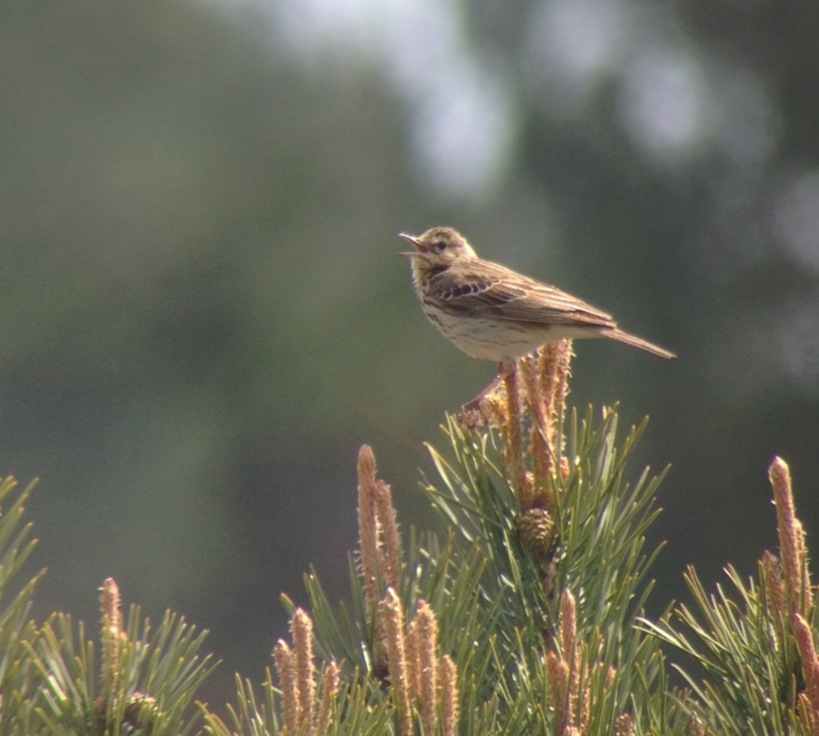
Tree Pipit, Morden Bog, 25th May
It has been a while since I have been able to go birdwatching, and it seems that I have missed what has been a rather poor spring for the southwest (while the east coast seems to be swarming with rarities!). We started at Wareham Forest, where I soon picked up two very overdue new birds for me in Britain- woodlark and tree pipit- not the most exciting pair of lifers! Other than these two species, there was very little around at Wareham, with a kestrel and sparrowhawk being the best of the rest. We then headed over to Morden Bog, where there were a pair of gadwalls and three teals on one of the ponds. A peregrine and several buzzards went over, and more excitingly we found my second ever Dartford warbler skulking in some gorse. I also saw my first hobby of the summer, one of my favourite British birds, and heard my first cuckoo (in fact I heard three of them). It was a very pleasant morning with two lifers for me in Britain and five new birds for the year.

Remarkably, on the 27th, we had a third new garden bird in less than two months, and the sixth of the year, with a garden warbler present. Despite its name, I had never seen one in a garden before!

Tuesday, 7 May 2013

Another new garden bird

I had a completely unexpected surprise on the 6th with a new garden bird that I could never have predicted- two whimbrel flew over not too high, presumably birds heading north up to the Somerset Levels. It became the 85th species I have seen at Hilfield, and the 59th for the garden this year (since my last post, I have seen Hilfield's first swift and house martins of the summer). Another new species for the year was a green woodpecker  near Hilfield on the 7th. On top of that, a peregrine and a sparrowhawk headed high over Hilfield on the 6th, and there were dozens of swifts and house martins in Sherborne.

Sunday, 14 April 2013

Another new garden bird!

Finally, there has been some good migration at Hilfield this weekend. Swallows are starting to pass over at a good rate, and the blackcaps have finally returned, with two in trees where the willow warblers were two days ago (they all seem to have moved on). The biggest surprise, however, was a single sand martin that passed over. An unexpected new bird for the garden! Another sand martin appeared on the 15th, which showed much better than the previous one, as it feasted on insects low above the garden.
On top of that, for the first time since a weasel last summer, we had a new garden mammal. It was a hare that briefly appeared in the field opposite the house.

With chiffchaffs, willow warblers, blackcaps and swallows around, it's only a matter of time before the cuckoos, hobbys, nightingales and swifts return- even more soon should be our first house martins and whitethroats of summer- I'm already looking forward to it!


Friday, 12 April 2013

First garden spring migrants

Finally our first spring migrants of the year arrived today, with five swallows, six chiffchaffs and up to eight willow warblers (a garden record!)seen from the garden. On top of that a peregrine and sparrowhawk went over, and there were good numbers of stock doves, goldcrests and long-tailed tits around. That, combined with meadow pipit and collared dove, took the garden year list to 54.

Saturday, 6 April 2013

Stone-curlews!

We started the morning at Portland, hoping to chance upon the long-eared owl, but we were sadly unsuccessful. There were very few birds around, the best being two wheatears. As we headed back towards Weymouth, we found a ring ouzel in a roadside field- allowing far better views than the one I saw on the 24th March.
Ring Ouzel, Southwell, Portland 6.4.13


With news of five stone-curlews at Butterstreet Cove, we rushed over there. After about 45 minutes of searching, we found them- six of them! This number of stone-curlews together in Dorset is unprecedented- part of a mini-influx across the south of the country right now. It was my first of the species, although they bear a great resemblance to the spotted dikkops I see in Kenya. Their British population decreased by 85% between the 1940s and 1980s- but thanks to the RSPB, their numbers are now slowly increasing. This mini-influx is certainly a promising sign. Unfortunately they were too distant for any decent photos, but I'm not complaining!
I know- it's shockingly bad, but it was the only photo I got of it that was recognisable as a stone-curlew!

In the field with them was a wheatear, and nearby some linnets, and two overdue year-ticks in shelduck and redshank.

We then headed to Lodmoor, where we failed to locate the spoonbills, but did find four little ringed plovers (again part of a small influx currently in the south of England), and our first swallow of the year. That, combined with the song of chiffchaffs, gave a real sense of spring having finally arrived.

At Radipole, we found the hooded merganser immediately- debate over whether the bird is genuinely wild will never end, but my view is that it is wild. We failed to find the garganey at North Hide, and overall, there were very few birds around. The best we could find were two singing willow warblers, and two more swallows over, along with dozens of sand martins.


Hooded Merganser, Radipole, 6.4.13